

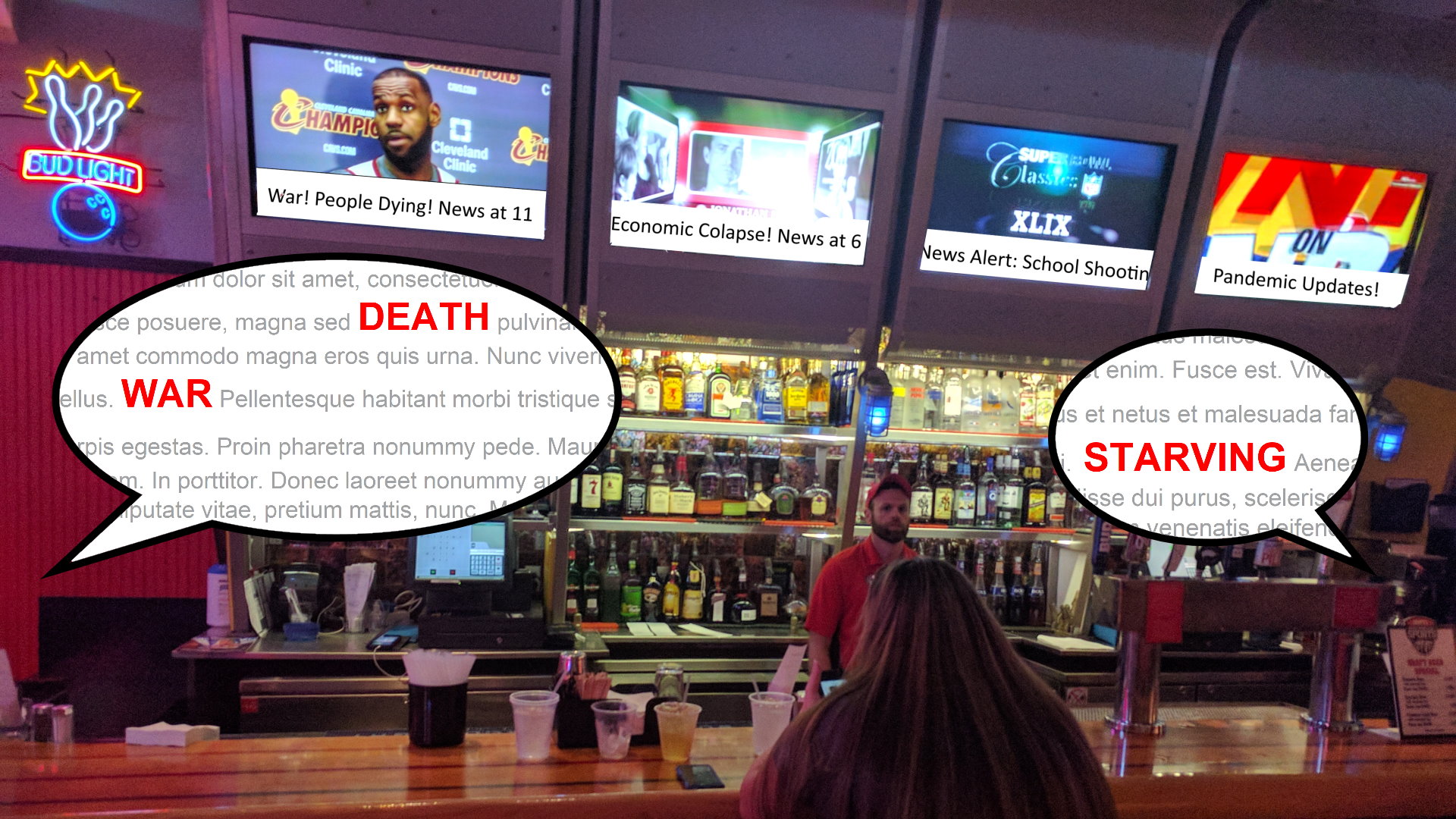
I don’t like feeling helpless. I don’t like bullies. I had to deal with this when Russia first attacked Ukraine. It was arguably a situation with a superpower bullying a significantly weaker country. I know very little about the conflict other than that. Why? I had to go out of my way to know as little as possible on purpose. As I said, I don’t like feeling helpless or watching others who are helpless, especially at the hands of a bully. Neither of these attributes are unique to me, but I think they do have a unique effect on me. Watching the news unfold, especially with these kinds of triggers, one nation mostly helpless against a bullying superpower, is bad for my health. I have this response with almost all conflicts. It’s not just limited to nation states, it could be conflict among friends, family, at work, really anything. I say that because, for whatever reason, conflict has a tendency to incite intense anxiety in me which leads to the fight or flight response. Overtime helpless situations lead to hypertension, sleeplessness, and many other physical reactions which are universally bad for my health. I’m getting older, and as much as I enjoy information and being knowledgeable about things going on in the world, my health has to take precedence. This means the best way to deal with things I can’t change is to minimize my exposure to them. Unfortunately, sometimes, this can be a big problem.
The war between Russia and Ukraine was the new big platform story. It was as big as the COVID-19 pandemic was. That means the dialog about the war was top of mind for everyone and all consuming. It’s these big news stories, these platform stories, that become part of the national discourse, that are especially difficult to get away from. Unlike the pandemic, where I wasn’t trying to avoid the news, the war made me realize how difficult it is to eliminate a ‘big platform story’ topic from your life.
It’s incredibly difficult because it’s absolutely everywhere. It’s in every social media feed. Even the ones like Google News that have highly refined algorithms which are supposedly customized to only deliver news that matches your specific personality. Well, personalized news that will keep you scrolling and seeing the ads embedded in the news feeds. Not only is it always there, it’s always the first story in the feed. I guess this is the modern equivalent of “Above the Fold” from the newspaper days.
It’s not just the virtual interfaces, it’s everywhere there is public information displayed. I go to craft breweries in the months that I’m drinking. As a way to fight what I think of as the battle of the bulge,i.e. my weight, this year i’m only drinking every other month. In my “enjoy the fruits that life has to offer” months, I like to go to craft breweries. I drink Kolsch and Lagar’s, have the occasional giant pretzel and hang with friends or work on my laptop. Often the only thing playing in these social spots is sports. In these breweries, and really most bars, sports are on every single TV 24/7. I only know of two bars that have music videos or other nonsense playing but that is typically only a single TV out of what could be dozens of them in the venue dedicated to sports. During the pandemic, and then during the war, it seemed every commercial break between plays included war updates. Even with the sound turned off it’s hard to miss the B-roll and the lower 1/3rd’s continually scrolling doom and gloom filled updates. If you choose a place that doesn’t have TV’s like a coffee shop or just a restaurant, you still can’t get away from the story. For big platform stories, it’s inevitable patrons all around you will talk about it constantly and loudly!
The reason why I think of the big story as the platform story is that it’s a story that others can build on. That’s what a platform is in the world of information technology. Microsoft Windows or Apple’s iOS are considered platforms. Programmers build programs to work inside those platforms. For the media it’s a bit of the same thing. If it’s really big, like Russian / Ukraine, then you’ll see news outlets building stories around the big platform, even in specialized media that’s unrelated. I can think of several examples. I’ve seen gaming focused web sites which usually only review video games, build several stories around the challenges facing Ukrainian game development studios in the war. I’ve seen auto websites have car story related war updates. All of my economics podcasts transitioned to non stop reporting on the various factors related to the economics of war for weeks. Even the Cruise industry related blogs and websites have stories about changing itineraries.
I get why all of the media outlets are doing this. It’s very difficult to create a stream of media that seems new and fresh. I continually struggle with it in my blog and podcast. For media outlets a war, and any big platform story, is a god send, at least from a creative perspective. Platform stories offer a fresh new angle on everything these outlets do. It’s also a virtuous spiral. Something big happens, then people start reporting on it, which inspires other people to report on it, and new story angles beget new conversations, keeping the whole thing in the public mindset.
Ultimately, from a media perspective it’s inescapable. It even bleeds off into areas you’d never expect it to. You’ll see physical signs in people’s yards and bumper stickers. I think the most egregious example of this so far was a popup notification in my Gmail about supporting Ukraine.
For the record, I understand there is some value in knowing what’s going on and what is going to happen in something like a War. I know the conflict will affect my life in very real ways like fuel prices and my retirement portfolio. I know there will be overarching uncertainty in the economy which will affect things in my local town. That doesn’t change my base philosophy, which, if I can’t do anything about it, and knowing this information stresses, or causes personal / emotional issues, ultimately it’s best to not know and deal with the issues as I encounter them.
The way the world acts when there’s a big platform reminds me of the old Dr. Laura radio show. Dr. Laura, was a conservative jewish family counselor who used to broadcast nationally on AM radio. I would listen to her on occasion. In at least one episode she was asked about Infidelity. Not traditional infidelity, she was asked about the type that is a one-time infidelity. The classic “we got drunk and made a poor choice” type. The type that really won’t happen again. She argued that the cheater should keep their mouth shut even if they feel really guilty about hiding something from the spouse. Of course this goes against traditional thinking. I.e. come clean. She argued that the reality is that the only person who gets better in that situation is the cheater and they do it at the expense of the person being cheated on. She maintained that it’s best if the person being cheated on is blissfully ignorant and the person who’s cheated, just bears the burden. In her opinion there is no sense in making the situation worse. Again, this is only a viable course of action if the cheating really was a one time stupid decision. The point of the Dr. Laura reference is that the media, especially the unrelated media, is acting like the cheating spouse. Their actions are really helping them, and not the people they are serving. When I go to a car website I want to read about how I can’t order the cool new Maverick, when I go to a gadget website I want to read about the latest iDevice dujour and when I go to a video game website, I’d like to see a review of the latest Sony Blockbuster.
These sites do it for eyeballs. I know many people with obsessive personalities, all they want to talk about is doom and gloom. When there isn’t a blockbuster story in the media, they really come out in election season. It’s easy to tell these personality types. No matter what side they are on, the other side is going to destroy the world. This obsessive personality type was even pariodied in an episode of the satirical animated show South Park. In the show, which was ultimately a commentary on the way the world was reacting post 9-11 attacks, Sharon Marsh, Stan’s mother, spends the whole show catatonic and lying on the couch all day watching the news.
So of course media companies show us what’s bad. As the old adage goes, if it bleeds it leads. Seriously, when was the last time there was a national story about a political party mostly getting along and furthering an agenda in alignment with the other party? All I ever see is stories about splinters in one political party or the other. The unrelated media companies know this type of big platform story, for some people, can get all consuming to the point of being an addiction, i.e. the Sharon Marsh parody. They know they will grab some new patrons they don’t usually have in their regular traffic if they try and integrate it. Consequently you see a story about the lost collectable cars in the Ukraine or the Ukraine game studio that may never finish its game.
So if it’s everywhere, if it’s in every piece of media? If it’s in the local bars? If it’s all around you at work? If it’s all everyone wants to talk about? How can you get rid of this type of caustic media?
One option is to try and punch out of the news cycle completely. Don’t go to socal places where there are TV’s on the wall. You can aggressively ignore or delete news sources from any news feed that includes content you don’t like. You can even tell friends, or other loud people sitting near you, that you don’t want to hear about it because it upsets you so much. Usually people will respect that. Sometimes all this effort works, sometimes it may not work. Remember, the algorithms employed by the big tech media companies puts the paid content creators first. These are often big news companies trying to attract eyeballs to their respective sites. We can’t forget that the purpose of the news feeds are to make money and if they have to put the desires of the people cutting the check ahead of the desires of the consumer to make a return on the investment it’s going to happen every time.
I honestly don’t think this is possible. Even if it were possible to completely shelter yourself from the major news, be it a Presidential Election, an all encompassing social movement like Black Lives Matter, or a war, there is a major negative. Specifically you keep out the good with the bad. You lose connection to others, especially those in your life who are either addicted to drama or just like to pay attention to it. Another option is to just try and manage the input. Attempt to turn the roar into a whisper. Just read headlines and summaries. Don’t go in depth. Get a feel for the big picture, and try to avoid the details.
Of these options, I think, especially for those where the bad news affects your health, the best one is to simply try and shut it all down. I cite my grandparents as a personal example. My grandparents would fret over world events. It made sense, they were part of the World War II generation. To them, world events meant massive changes at home to their life and family, up to and including loved ones dying. Technically it’s possible to have a War like that, but it’s unlikely. It wasn’t just Caustic Platform Stories like war or famine my grandmother stressed over, she worried about almost everything. A trait I think, unfortunately, she passed down to me. Ultimately, my Grandmother died of a huge stroke. To me that’s a big lesson. I don’t think she died because of relentless exposure to Ethiopian Starvation videos and news stories, but I’m sure it didn’t help her. For the record, the Ethiopian famine events were, and are, a situation that couldn’t be fixed. No matter how much money and food wealthy nations would send, the effort never worked as the resources were simply stolen and used by the tyrannical government to support its own goals.
The bottom line here is that if I have to stop going to public places, stop turning on the TV and stop checking the news feeds so I can avoid the effect of an omnipresent caustic news story on my health, I will. I will also turn off the podcasts and pull out my ancient CD collection for my car rides. I’ll shut it all off. It’s never easy. The big platform stories have long tails, and by their nature are everywhere. The positive side of not consuming media is more time to do other things like blogging, podcasting, working on projects for my day job, and exploring all those things I have been putting off for far too long. I said at the beginning that I hate feeling helpless and I hate bullies. In a roundabout way, by not engaging, this is definitely one thing I can do to not feel helpless. I say that because awareness is a form of empowerment and there was no way I was going to empower Russia, or any other bully with my attention.

 Home of Peluso Presents