

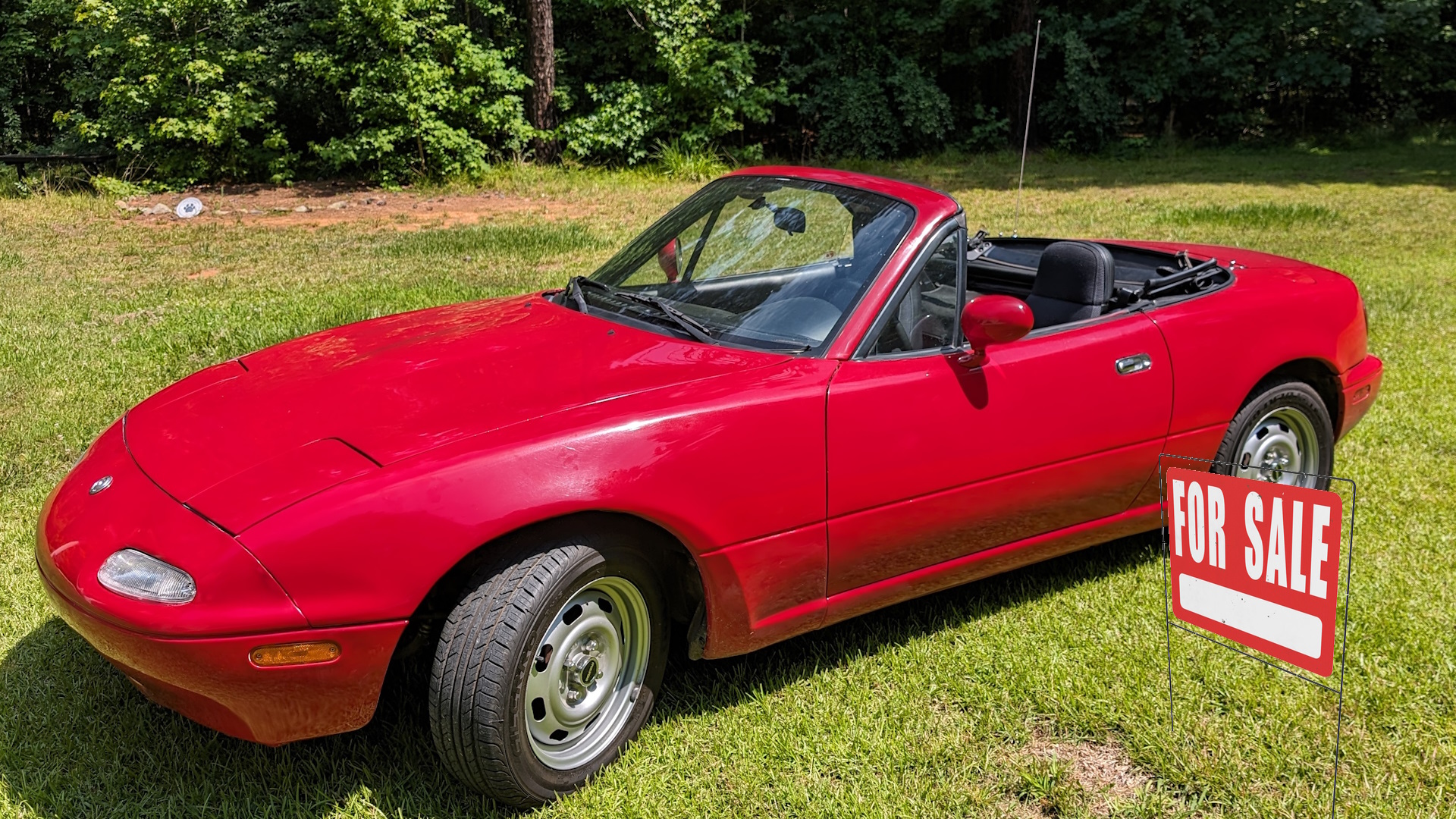
I got back from a long family trip and pulled my Miata out of the garage. The Miata is my dream car. It’s also my project car, one with a long, emotional and very interesting story. I had just spent thousands of dollars on getting the body work done. Because of that I convinced my wife that I needed to keep it in the garage. When I pulled it out, there was a good sized spot of some fluid on the floor of the garage. At first, I thought it was power steering fluid. I made an appointment with my local repair shop to get the engine looked at. Several weeks later (I told the shop owner there was no rush) I got the call. It was a gut punch. It was an oil leak. That in and of itself isn’t so bad. The problem was where the leak was located. To repair the leak, the engine had to be pulled. The job would take 20 hours minimum, and at the $100 an hour the shop charges, the bill would be over two thousand dollars. Normally, I’d groan, and find a lower cost solution and just accept the fact that I signed up for this type of thing when I took the project on. Unfortunately, this wasn’t my only car problem.
I also have a Scion XB. It’s been a reliable little car, but it also has an oil problem. It’s not leaking oil, but it’s starting to burn oil. This is to be expected, it’s got over two hundred thousand miles on It. I have to put in a quart about every month or so. In addition to the oil problem, there is an intermittent issue with the oxygen sensors which could be related. Sometimes the lights come on, sometimes they are off. There have been other issues requiring more frequent trips to the auto shop. There are also some issues that aren’t in need of immediate attention, but I can see where they will turn into a repair bill at some point. The bottom line, at least if you want reliable transportation, is that it’s probably time to say goodbye to my little box.
Getting a new car, at least now while I’m writing this article, is challenging. The Covid-19 pandemic and associated supply chain problems, inflation, and UAW strikes all have combined to drive pricing through the roof for new and used vehicles. This is a huge issue for someone like me who’s a value conscious consumer. I like to get as much value as possible for my dollar. That’s why I bought the Scion. It was the best value economy car of its time. It was the most reliable and had the most cargo space relative to the price. Sadly, it’s no longer available.
I knew this day was coming and I’ve been laying the groundwork. The current new vehicle that’s comparable to the scion from a value perspective is the Ford Maverick. I identified that it’d be the new value leader providing the most vehicle for the dollar. Unfortunately, the rest of the world knew this as well. The year it was introduced it immediately sold out in minutes. I went to my local dealer at the time and they told me that I could buy one the second year. Over the course of the first year a frenzy had started and the Maverick started selling for 30% more than the sticker price. When the order books opened in year two the Maverick sold out in minutes. When I inquired at my local small town Ford dealer, reminding the owner he told me I could buy one at sticker price, he sheepishly told me that they were going for six thousand over sticker with the implication that I need to pay that much if I want one. I told him thank you but no thank you. Then year three rolls around and I reached back out with an email asking if I could buy one at sticker. Shockingly, I didn’t get a response from the dealer, it was from Ford and the email was to confirm my order.
This was good, and it solved one problem, the issue of the aging Scion, but it created another. I don’t like debt and this new vehicle, even though it was value-oriented, was going to cost nearly thirty thousand dollars. In the mid 2020’s that’s inexpensive for a new car, but it’s still a huge chuck for someone who likes paying cash for vehicles and who’s job title is ‘teacher’. So I had to consider my options.
I could turn down the Maverick. I knew the dealer put in the order without asking me if I was ready to buy because he could sell it in an instant. If I did that, I still have the issue of the old Scion needing ever escalating levels of investment as the thirteen-year-old vehicle continues to break down in innumerable ways.
I could liquidate assets like my savings account and retirement accounts and pay in cash. This would put me in a precarious position in having a minimal buffer and leveraging my future for my present. This is not a good option for many reasons. Finally, the last option is that I could be like everyone else and just make a car payment. I hate car payments. It’s not just car payments, I hate ALL debt. I know from years of experience, having a car payment limits your life in so many ways.
So what should I do? When I look at the whole picture, I need a new car and I have an asset. The asset is my dream car, the Miata. The bottom line is do I want debt or do I want my dream car, a car which is essentially a toy? Even with all the emotions wrapped up in the Miata, the answer, for me at least, is clearly, and definitively, a preference for zero debt. That means I need to sell the Miata. In its current condition I could get roughly six or seven thousand dollars for it, or about what I put into it. I’m thankful for that, theoretically it’s not a huge loss. Between that, savings, and selling the Scion, I should be able to buy the Maverick with zero debt.
The bigger conversation actually revolves around the hard decision. I’ve heard that phrase every time there is a layoff at a big company. The quote from the CEO in the news article or the line in the press release is usually “We unfortunately had to make some very hard decisions.” I’m sure for a small subset of CEO’s it’s actually a truly hard decision. I’m sure they agonize over every single person whose life is thrown into turmoil. For the majority of the companies, and related corporate leadership, it’s not as hard as they make it out to be. It’s simply a spreadsheet decision.
That’s my point. “Hard decisions” are made by humans. They are personal. Most decisions made by corporations, at least the ones run by board appointed CEO’s, aren’t really “hard decisions.” They are simple business decisions. Truly difficult decisions have emotional impact. It’s easy to look at a spreadsheet, look at the HR budget, and let people go based upon projected business needs, revenues and share price. For a corporation, a harder decision revolves around keeping people in spite of the current share price, or making sure they are well taken care of if you really have to let them go due to a fundamental change in business dynamics.
For average people, the hard decision is hugely impactful. In my case it’s all about giving up my dream car because I have committed myself to a no-debt lifestyle. For others it’s even much more impactful than that. It could be related to children or even lifesaving health care decisions.
These decisions aren’t made out of the blue. They often exist because of that gut punch moment. In my case it was the call from my mechanic. It could be the call from the doctor or the boss. If you are a business leader it’s some unique change in the dynamic of your business and you can’t sustain the model or growth that doesn’t meet expectations.
I do think that for entrepreneurial CEO’s, the ones who built the business from the ground up, negative decisions resulting in department closures or big layoffs can be very hard. This is because they are emotionally connected to the organization’s goals and workforce. But, they, and the board appointed CEOs who really do care about their people are very much in the minority.
So what do you do when there are hard decisions to be made? Well if you are a CEO, you send an email to the remaining staff and put your best spin on the situation and try to muster morale until the next hard decision has to be made based upon quarterly numbers. That’s another big point to this article, “Hard Decisions” typically aren’t a one and done event. They are part of a trendline. This means if you are at a company where there was a layoff, then it’s time to take a look at your environment and get ready to make a move, even if you don’t want to leave your position.
It’s more nuanced when it’s something personal. You may be reeling emotionally from the gut punch that caused you to make decisions you don’t want to make. The last thing I want to do is to sell my Miata. That being said, I know the oil leak isn’t the only issue I’m going to run into with a vehicle that’s over a quarter century old. I know that there will be other big expenses in my life that I’ll have to deal with. I know I’m not a gear head, at least not mechanically. Electronically it’s a different story. I know that when I have to make a choice between no-payments and a toy car, even one I wanted my whole life, the desire for no-payments wins hands down.
No matter what facet of life you deal with, health, work, relationships, or anything else, unexpected negative events, i.e. gut punches, are going to happen. At that moment, you may have to make a change in what you are doing, and how you are doing it. This is the point where the hard decision comes in and they are exactly that, decisions that are emotionally hard to make. There is going to be an unwanted loss. In these situations we have to try and clear the emotions and do what we need to do. It’s never fun, but for individuals, there is a benefit to the hard decision. It causes us to change our thinking. Every hard decision we make today avoids one in the future. I know that as much as I love my Miata, and as inexpensive as it is relative to my current income, I still can’t have one unless every other need in my family has been met.
For corporations, hard decisions typically don’t change their behavior. They will be happy to make another hard decision during the next stock slump. So if you are with one of those corporations, the ones who use the term “Hard Decisions” a bit too frequently, then maybe you have your own hard decision to make. A decision where you have to walk away from something comfortable and lucrative to something that’s more stable and a better fit longer term. Like having to sell my Miata, it may be a challenge and disappointing, but the benefits, especially the long term benefits, outweigh the costs. Hopefully, knowing that will make the decision a little less hard.
Like what you read?
I spend hundreds of hours working on these articles every year with no compensation other than support I get through donations. You can support with a tip and by subscribing to the podcast (and writing a review on iTunes would be really appreciated as well!)
One time tips:
https://venmo.com/pelusopresents
On Going
https://www.patreon.com/PelusoPresents
In addition to subscribing here on Medium.com, you can also find more writings by Mike Peluso at:
The Blog:
With hundreds of archived articles, Peluso Presents is your source for commentary, ideas and insight in navigating the collision points between work and life.
The Podcast:
http://pelusopresents.libsyn.com/
For those who are on the go, every episode of the Peluso Presents podcast includes a reading of a highlighted post as well as other great entertaining information. Available wherever you get your podcast fix from! Subscribe on iTunes!
ITUNES: https://itunes.apple.com/us/podcast/the-peluso-presents-podcast/id1143822193?mt=2&ls=1
GOOGLE PLAY: https://play.google.com/music/podcasts/portal/
RSS FEED: http://pelusopresents.libsyn.com/rss
Twitter: https://twitter.com/PelusoPresents

 Home of Peluso Presents